Arabic & English Shapes Flashcards: A Visual Learning Tool
Finding the right educational resources that bridge languages and cultures can feel like searching for a needle in a haystack. When you're working with young learners—whether in a preschool classroom, a homeschool setting, or even at the kitchen table—you need materials that are visually engaging, easy to customize, and genuinely useful. That's exactly where Arabic & English Shapes Flashcards come into play, offering a bilingual approach to one of the earliest concepts children explore: shapes.
Why Bilingual Flashcards Matter for Early Learners
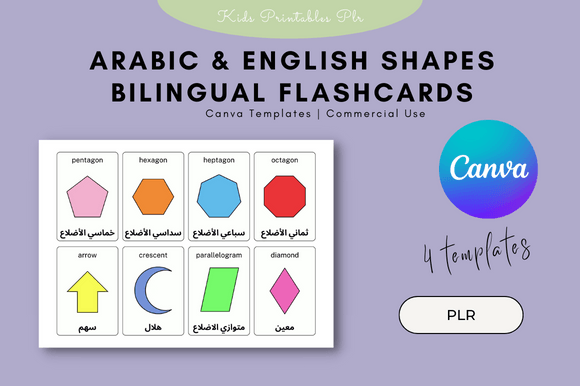
Children absorb language naturally when they encounter it in meaningful contexts. A square isn't just a square—it's a murabaa in Arabic, and when a child learns both words side by side, they're building neural pathways that support cognitive flexibility. These flashcards present fundamental shapes—square, circle, rectangle, and triangle—in both Arabic and English, making them an invaluable resource for multilingual families, Arabic heritage learners, or any educator who wants to introduce a second language through visual recognition.
The beauty of this particular set lies in its simplicity. Each card features a clear shape illustration paired with its name in both languages. There's no visual clutter, no distracting backgrounds—just clean, purposeful design that keeps young eyes focused on what matters. For content creators and designers who work in the education space, this kind of restraint is a masterclass in effective visual communication.
Customizable Canva Templates That Save You Hours
One of the standout features of these flashcards is the inclusion of four editable Canva templates. If you've ever spent hours trying to create educational printables from scratch, you know how valuable a solid starting point can be. These templates are designed for Canva's free version, which means no additional software costs—just log in and start editing.
What can you actually change? Quite a lot. The color palette is fully adjustable, so if you're creating materials that match a classroom theme, a brand identity, or a specific aesthetic preference, you can shift the hues in seconds. Fonts are also editable, which opens up possibilities for educators who want to emphasize specific letterforms or match existing curriculum materials. And if you want to expand beyond the four core shapes, you can add more—pentagon, hexagon, star, heart—whatever your lesson plan requires.
This level of customization transforms a simple flashcard set into a flexible design asset. Small business owners who create educational products can rebrand these templates and offer them as part of their own digital product line. Bloggers in the parenting or education niche can use them as lead magnets. The templates essentially give you a professional foundation without the professional price tag.
Tracing and Coloring Pages That Build Motor Skills
Beyond the flashcards themselves, this set includes tracing and coloring pages—an addition that elevates the entire package. Young children don't just need to recognize shapes; they need to interact with them physically. Tracing builds fine motor control and hand-eye coordination, while coloring reinforces shape recognition through creative engagement.
For homeschool parents, these pages serve double duty as both art activities and geometry lessons. For preschool teachers, they're perfect for quiet time stations or independent practice. The dual-language labeling on these pages means children are encountering Arabic and English vocabulary repeatedly without it feeling like rote memorization. It's learning disguised as play, which is exactly how early childhood education should work.
Practical Applications Beyond the Classroom
If you're a designer, marketer, or content creator, you might be wondering how shape flashcards fit into your world. The answer is broader than you'd expect. Shapes are foundational to visual communication—every logo, every layout, every piece of packaging starts with geometric principles. Understanding how to present shapes clearly and attractively is a skill that translates directly into professional work.
Consider these real-world applications:
- Brand identity projects where you need to communicate simplicity and approachability
- Packaging design for children's products, educational materials, or bilingual goods
- Social media graphics that teach a concept while building audience engagement
- Blog content for parenting, education, or multilingual living niches
- Print materials like classroom posters, activity sheets, or homeschool portfolios
- Digital products sold on platforms like Etsy, Teachers Pay Teachers, or your own website
The bilingual element adds a unique selling point that many competing products lack. In an increasingly global marketplace, resources that support Arabic language learning carry significant value—both as educational tools and as commercial products.
Design Principles Worth Noting
What makes these flashcards visually effective comes down to a few key principles that any designer or creative professional can appreciate. The shapes are rendered with clean lines and solid fills, ensuring instant recognition even for the youngest learners. The typography—across both languages—is sized for readability, with Arabic script given proper space and English text balanced alongside it.
Color contrast is handled thoughtfully. Shapes stand out against their backgrounds, and text remains legible whether you're viewing on screen or printing at home. These aren't afterthoughts—they're the difference between a resource that works and one that frustrates both educators and children.
For anyone working in editorial design, web design, or print production, paying attention to these details is non-negotiable. A flashcard set that nails readability and visual hierarchy teaches you something about your own projects, even as it serves its primary educational purpose.
Making the Most of Your Flashcard Set
Once you download the templates, take a few minutes to plan before you start editing. Think about your specific audience. Are these cards for toddlers who need bold, high-contrast visuals? Adjust the colors accordingly. Are they for slightly older children who are beginning to write? Make sure the tracing pages have appropriate line weights. Are you creating a product to sell? Consider adding your logo, adjusting the color scheme to match your brand, and packaging the final result as a cohesive set.
Test your printed versions before committing to a full run. Colors shift between screen and paper, and what looks perfect in Canva might need minor adjustments once it's physical. Print on cardstock if durability matters—flashcards get handled, bent, and occasionally chewed on. Laminating is another option that extends the life of each card significantly.
For those using these as part of a commercial font or design asset strategy, remember that the templates are your starting point. The real value comes from how you adapt, brand, and present them. A well-curated set of bilingual educational materials can become a cornerstone product for an online shop or a signature offering for a tutoring service.
Arabic & English Shapes Flashcards aren't just a teaching tool—they're a canvas for creativity, a bridge between languages, and a practical resource that respects both the learner and the educator. Whether you're teaching your own child the difference between a triangle and a rectangle or designing a product line for a global audience, this set gives you what you need to start strong and build something meaningful.